Japanese City Says Its Property Records May Have Leaked Through a NIKKE Launcher Infection
By CriticalPixel ·
Iwamizawa is a city of roughly 75,000 people in Hokkaido, and it just published the kind of notice no games company wants to read. On November 18 the city said a subcontractor's machine had been infected with K2F, the same remote access trojan tied to the compromised PC launcher for Goddess of Victory: NIKKE, and that municipal property records were sitting on that machine when it happened. Nobody has confirmed a leak yet. That is the only reassuring sentence in the whole document.
What the city put on paper
The notice is specific about the data. Land records for up to 10,348 parcels and house records for up to 7,037 buildings, both current as of January 1, 2022, were stored on the affected device. The city lists location, cadastral details, land category, and assessed unit price among the fields, and states that no My Number identifiers were included. It also says there is no confirmed external leak or misuse at this point and that the scope is still under investigation, which is the standard wording for a situation nobody has finished measuring.
The timeline is the part that will make procurement people wince. RimGate found the malware traces on November 4 and cut the machine off the network the same day. It reported to its client GIS Hokkaido on November 9. GIS Hokkaido told Iwamizawa on November 16. Twelve days passed between discovery and the city learning that its tax records might be exposed, which is not unusual in a chain of subcontractors and is still terrible.
The NIKKE link is confirmed, not speculation
GIS Hokkaido confirmed the connection to ITmedia on November 19: the NIKKE PC launcher was involved. Asked whether a RimGate staffer had launched the game on a work computer, the company said it would prefer not to answer, which is a sentence doing an enormous amount of work. The neighboring town of Shintoku published its own notice the same week, with 6,001 resident registry entries and 986 disaster evacuation support records potentially exposed.
K2F is not nuisance adware. It is a remote access trojan that lets an operator run commands, browse and pull files, grab screenshots, and lift credentials saved in browsers, according to Automaton's reporting. Researchers track it as k2f-agent, players nicknamed it k2f-chan, and the joke stopped being funny somewhere around the first municipal disclosure.
What Level Infinite told players
The publisher moved quickly once it had confirmation. On November 4 the official NIKKE account said some files in the Windows PC launcher had been tampered with by a third party, and by 12:09 UTC+9 that day security measures were complete and further malware distribution through the launcher was blocked. The same notice says the official launcher resumed normal service and asks anyone who ran it before the fix to follow the security check steps, with an apology attached. That is the right sequence. It is also a sequence you only get to run after the damage is done.
How the room reacted
Reaction is concentrated in Japan and it splits two ways. One camp is trading jokes about a municipal employee queuing dailies on taxpayer hardware, which is fair, because the city's notice reads like a punchline with a case number attached. The other camp is doing the boring work of checking machines and sharing fixes. English language coverage has been thin outside a couple of outlets, and no major platform holder has said a word about launcher security this week, which is its own kind of answer.
The CriticalPixel take
A game launcher is a program that downloads and runs code on your machine by design, so when an update pipeline gets compromised the blast radius is every player and every machine that player touches. That is what makes this bigger than one gacha game. A contractor holding a municipal tax contract had NIKKE on a work PC, and a city of 75,000 is now writing disclosure notices. Studios cannot control what people install, but they can ship signed updates, publish hashes, and stop treating launcher integrity as somebody else's problem.
The harder question is accountability. Iwamizawa's notice does not name the game, GIS Hokkaido would not discuss who did what, and NIKKE's statements focus on remediation. All of that is legal and none of it tells a resident whether their land parcel data is floating in an attacker's folder. What to watch is whether more municipalities disclose. Shintoku already has, and Japan has spent recent months watching Sega's arcade network go down, Capcom lose account data, and a teenager walk into Bandai Namco, so the appetite for these notices is not going away.
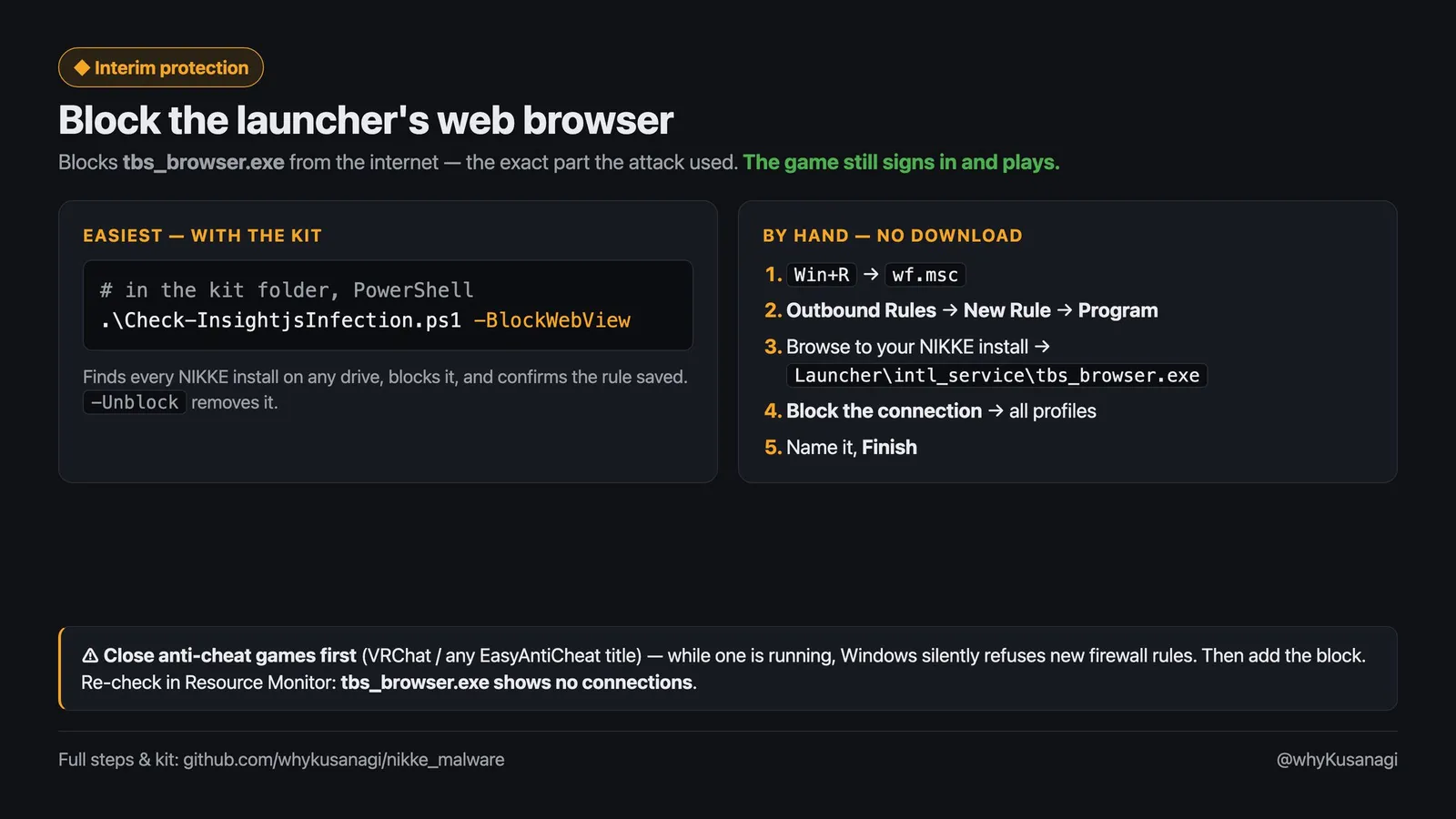
For players, the practical advice is dull and worth repeating. If you launched the NIKKE PC client before November 4, run the checks the publisher posted, change any passwords a browser saved on that machine, and reinstall Windows if you want to be certain. For everyone else, remember that the next launcher bug will not arrive with a cute nickname. It will show up as a notice on a city website, weeks later, with a count of affected records attached.
Sources
GameSpot: Malware linked to NIKKE cracks city security
Automaton: Iwamizawa city reports potential data leak tied to K2F malware
ITmedia: NIKKE launcher malware infection confirmed by Hokkaido contractor
Iwamizawa City: Notice on possible personal information leak
NIKKE official account: PC launcher security incident notice