Steam AI Disclosures Hit 49.9% of New Releases in October, Up From 1.7% in January 2024
By CriticalPixel ·
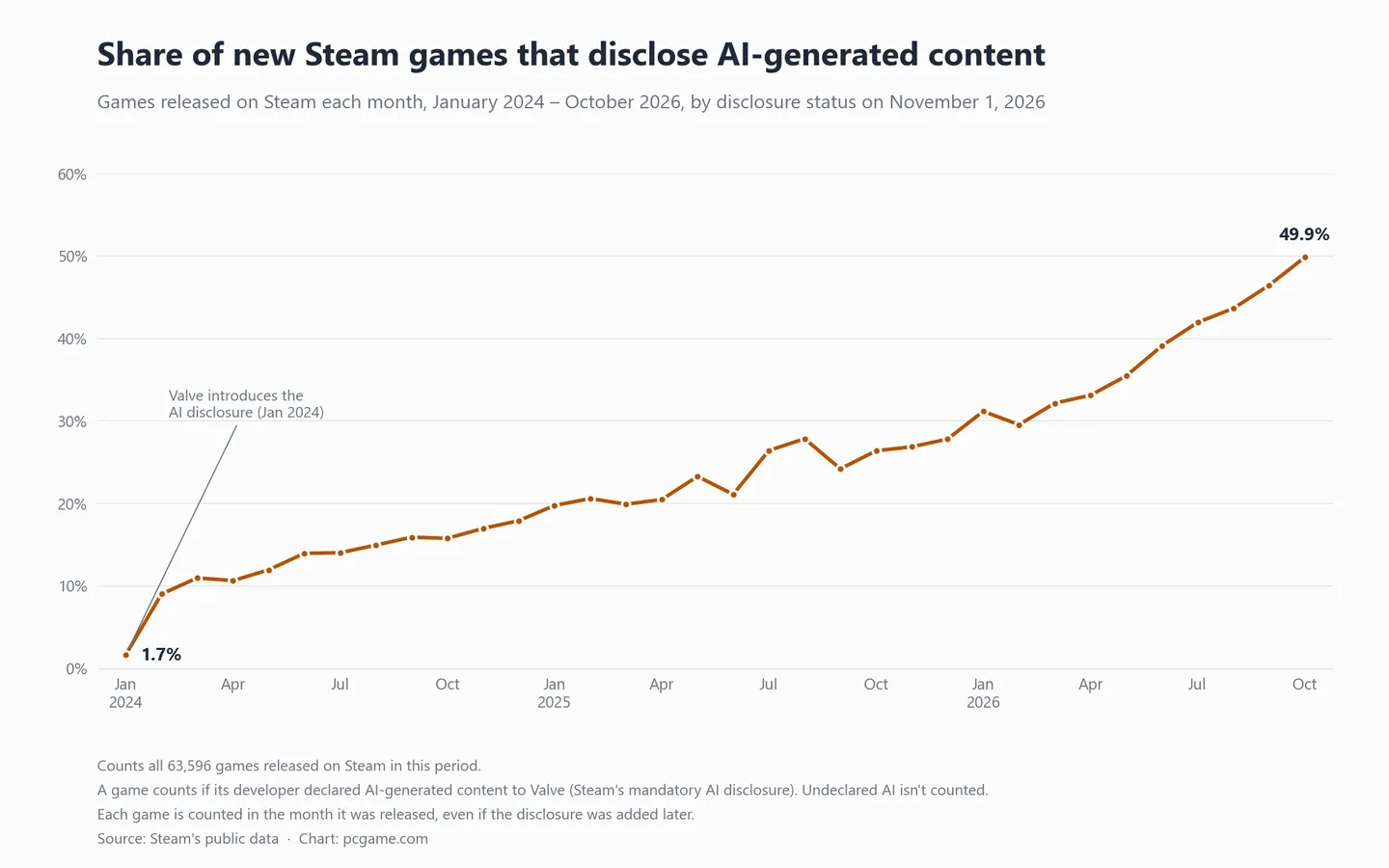
Nearly half of everything that shipped on Steam last month came with a small paragraph tucked into its store page, and that paragraph is the story. Of the games released in October 2026, 49.9 percent disclosed the use of AI generated content, according to an analysis of more than 63,600 releases that has been moving around since it went up on r/Steam. Nearly three years ago, when Valve first made that disclosure mandatory, the number was 1.7 percent. The jump is not a rounding error or a quirk of a quiet month. It is the shape of the platform now.
The Trend Moves One Way
The dataset runs from January 2024 through this October, and it climbs the whole way. Across all of 2024, 13.2 percent of new releases disclosed AI. That became 24 percent in 2025, 40.1 percent for 2026 so far, and 49.9 percent for October on its own. October 2025 sat at 26.4 percent, so the year over year move is close to double. Dexerto picked the numbers up on November 2 and framed it the same way, while GameSpot pushed the two headline figures out to its own feed that afternoon with nothing but a chart attached. That is how these findings travel now: a Reddit post, a couple of aggregators, then a wall of quote posts arguing about the same three sentences.
What Valve Actually Asks For
Valve's content survey has a third section dedicated to generative AI, and the Steamworks documentation is blunt about what belongs in it. Efficiency gains from AI tools are not the focus. What matters is AI used to build content that ships and gets consumed, covering art, sound, narrative and translation, and developers are expected to describe the implementation in detail, split between content pre-generated during development and content generated live while the game runs. In January 2026 the rule narrowed in a way that cuts both directions. Disclosure now covers AI output players can see or hear, not the tools sitting behind the scenes, so a studio can lean on AI for internal grunt work and stay quiet, while a solo developer who touched up one icon is still expected to say so on the page.
Small Games, Big Numbers
The breakdown is where the real story sits, because it does not read like a wave of blockbusters quietly outsourcing their art. Among 2026 releases with fewer than ten Steam reviews, 47 percent disclosed AI use. Among games with 1,000 or more reviews, that falls to 14 percent. Prolific developers disclose far more often than one and done teams, 68 percent against 37 percent, which tracks if you assume volume shops optimize for output per hour while a studio with a single release is protecting its name.
By category, art leads by a mile at 63 percent of disclosures, then text and translations at 30 percent, store page and marketing at 26 percent, music at 21 percent, and code at 16 percent. Voices show up in 7 percent, and only 3 percent say AI generates content while you play. Eight percent admit the disclosure was only ever about the store page, which is the funniest and most honest line in the whole spreadsheet.

Reviews, Receipts and Caveats
The analysis also lines up review scores, and the gap exists but it is small. Games with an AI disclosure average 77 percent positive against 83 percent for games without one, counting only titles with at least 50 reviews. That is a correlation with an obvious confounder. Small games dominate the disclosure pool, and small games also dominate the long tail of mixed reviews, so the six point gap says more about budget and polish than about whether a generated texture poisons a release. Anyone quoting that figure as proof players punish AI is overselling a spreadsheet.
The other caveat is self reporting. All of this depends on developers ticking a box honestly, and the count only includes what Valve's own data records. Undisclosed AI is invisible by definition, so 49.9 percent is a floor and not a ceiling, and the trend line measures disclosure culture as much as it measures actual usage.
The Community Is Arguing About the Wrong Column
Reaction on r/Steam has been mixed and technical rather than outraged. The loudest thread in the comments is disbelief that code sits at 16 percent, with one developer claiming AI now writes entire apps for them while another counters that shipping something scalable still needs humans who understand architecture and testing. There is the usual split between people who treat AI as a tool like any other and people who are sick of identical capsule art, plus a fair number of jokes that the other 50.1 percent simply have not filled out the form yet. It is a data argument wearing a culture war jacket, which is the most useful version of this conversation.
The CriticalPixel Take
A disclosure rate that triples in two years is not a scandal, it is an economic readout. Steam rewards volume, volume rewards shortcuts, and AI is now the cheapest shortcut in the building. Valve's answer has been to make developers admit it and then leave them to face the store page alone, with no filter, no tag, and no way to sort it out of your queue. The analysis makes the same point the reporting does: your only defense is scrolling to the disclosure box on every single page you open. That is not a policy, that is paperwork.
The number worth watching is not 49.9 percent. It is whether the October spike holds through the holiday release crush, and whether Valve ever gives players a switch to act on any of this. If half of new releases can wear an AI label while the store offers nothing to do with that information, the disclosure exists to protect Valve rather than to inform you. For a company that built its reputation on letting the storefront speak for itself, that is a strange place to land.
Sources
Dexerto: Almost half of all new Steam games use AI now
r/Steam: u/ploz analysis of AI disclosures across 63,600 releases
GameSpot on X: 49.9 percent of October Steam releases disclosed AI
Steamworks documentation: content survey and generative AI disclosure