Tencent Is in Talks to Offload Marvelous and Other Japanese Game Studios, Says Bloomberg
By CriticalPixel ·

Tencent is reportedly looking to offload minority stakes in several Japanese game studios, with Bloomberg naming Marvelous Inc. as the most concrete example. The Chinese gaming giant told Bloomberg it is reviewing its underperforming bets in the country and is willing to sell the shares back to the studios themselves, even if that means taking a loss on the deal. The story has been circulating on social media all morning, with Wario64 and Kotaku both flagging the report as a major signal of how Tencent is reshaping its global gaming strategy.

Bloomberg's report, dated June 23, says Tencent has been in active talks to sell its holdings in a number of Japanese developers it views as not meeting expectations. Marvelous Inc. is the only company called out by name, but the outlet specifies there are several others under review. The piece frames it as a strategy shift for Tencent, which now wants to move away from being a passive investor and into a co-production role with the studios it decides to keep. Tencent told Bloomberg that video games are core to its business and that it remains fully committed to its presence in the Japanese market over the long term, but the language is doing a lot of work to soften what is, in practice, a partial retreat.
FromSoftware and PlatinumGames Are Not on the List
One of the most important caveats in the Bloomberg report is what is not being sold. Tencent's bets on PlatinumGames and FromSoftware, along with its stake in FromSoftware parent Kadokawa Corp., remain completely unaffected by this round of divestment. Both studios are performing well commercially and are seen as flagship assets worth holding, which is why Tencent is keeping them. For Elden Ring fans, in other words, nothing is changing at FromSoftware. The interesting question is what the unnamed several others are, because the Japanese scene has no shortage of mid-size studios that have taken Tencent money over the last few years.

The AI Race Is Part of the Story
Bloomberg's sources frame the selloff as part of a broader internal rethink, and the trigger is reportedly Tencent getting outmaneuvered by Alibaba and ByteDance in the AI race. With Chinese tech companies pouring billions into large language models and inference infrastructure, Tencent is being forced to redirect capital, and gaming investments that are not pulling their weight are first on the chopping block. The report is also explicit that Tencent would rather sell the shares back to the studios' own management teams than dump them on hedge funds, which is the more dignified version of a forced exit. The market will not read it that way, though, because losing Tencent as a backer is a soft signal that a studio's commercial trajectory has flatlined.
What This Means for Marvelous
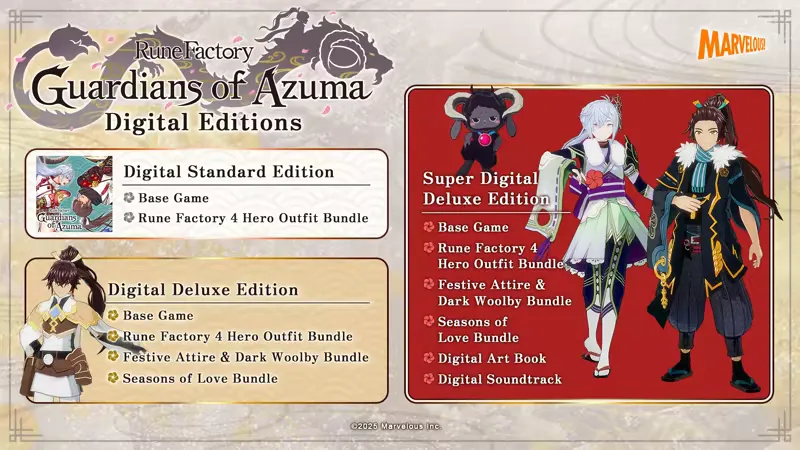
Marvelous, originally a Sega spin-off, is the studio most directly in the line of fire. It owns three of the most consistent franchises in the cozy and action-RPG space: Story of Seasons, Rune Factory, and Daemon X Machina. Rune Factory: Guardians of Azuma launched on Switch and PC in June 2025 and has been one of the better-received entries in that series in years, while Story of Seasons: Grand Bazaar released in August 2025 to mostly positive reviews. None of that was enough to satisfy Tencent, and the company is now in talks to walk away. Marvelous declined to comment when Bloomberg reached out, which is a familiar response from a Japanese studio caught in the middle of a deal negotiation. The next 12 months are going to be awkward for whoever is left holding the bag on the Marvelous side of the table.
Community Reaction Across Twitter and Wario64's Reach
The reaction online has been a mix of relief and unease, with the loudest voices being the Wario64 crowd that tracks every deal rumor in real time. Wario64's repost of the Bloomberg headline pulled in over 440 likes and crossed 100 million impressions within hours, and accounts like HazzadorGamin, Rino, and Pirat_Nation amplified the news with their own summaries. A common thread in the replies is that some Western players would rather not have Tencent anywhere near Japanese IP in the first place, and a selloff reads as a quiet win for creative independence. The Japanese-language coverage has been more measured, with most of it waiting for official confirmation before drawing conclusions. The bigger concern in the responses is that if Tencent is willing to take a loss, the studios on the chopping block may have been struggling long before the Bloomberg story broke, and the public is only finding out now.
CriticalPixel Take
For an industry already bleeding from layoffs, studio closures, and a stretched consumer base, Tencent pulling back from Japanese developers is another reminder that even the giants are not insulated from the current squeeze. The angle Bloomberg is selling is the polite one, the strategic refocus framing, but the underlying signal is that mid-tier Japanese studios are no longer a safe bet for Chinese capital. That matters because Tencent was one of the few deep-pocketed foreign investors that Japanese developers could pitch to without giving up creative control to a Western publisher. With Tencent stepping back, the realistic options for the affected studios narrow to Japanese conglomerates, Sony, and a handful of Korean and Chinese firms that are still flush. Story of Seasons, Rune Factory, and Daemon X Machina are not going anywhere, and FromSoftware is not at risk, so the immediate impact on players is effectively zero. The longer-term impact is harder to ignore, because every selloff like this is a vote of no confidence in the segment, and the segment has heard enough of those votes this year already.
Watch the Wire, Not the Press Release
Bloomberg's report is the first real signal that a quiet reshuffle of the Japanese gaming scene is underway, and it is unlikely to be the last. Marvelous has not commented, Tencent is keeping its public stance upbeat, and FromSoftware and PlatinumGames are not on the block. That still leaves a list of several other studios that have not been named, and the market is going to be guessing which ones for the rest of the summer. CriticalPixel will keep watching the wires and update this story as soon as there is a real confirmation from either side. Until then, treat every rumor of a follow-up sale with the appropriate skepticism, and do not let anyone convince you that one investor walking away is the same thing as a studio disappearing.