Valve Puts Steam Deck Framerate Data on Steam Store Pages, With a Histogram to Prove the Numbers
By CriticalPixel ·
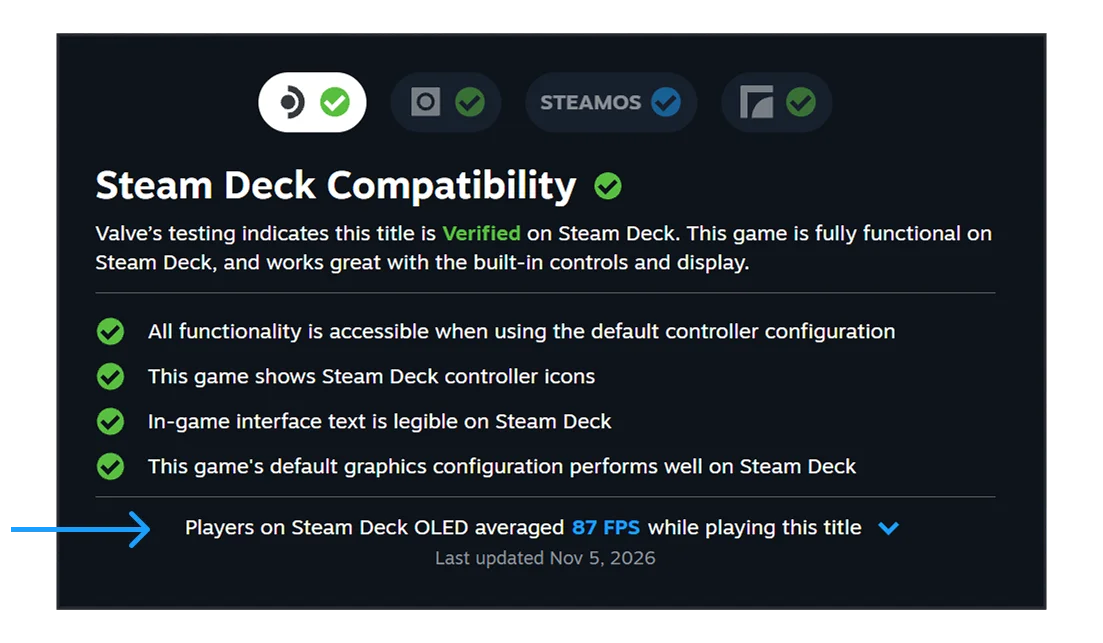
Valve quietly turned the Steam Deck into a benchmark you can shop against. With today's client update, every game that has been through Deck compatibility testing now shows the average framerate players actually get on the hardware, right on its Steam store page. Verified, Playable, Unsupported, all three tiers get the treatment. As of the announcement there are thousands of games with numbers attached, and Valve says the pile keeps growing. That kills the oldest argument in handheld PC shopping, namely whether that little green badge means anything for the game you are about to buy.
What you actually see on the store page
The number lives under Steam Deck Compatibility, behind a Learn more link on each game's store detail page. You get an average drawn from players who opted in, not from a lab bench with a single test build. Valve claims a majority of Deck players have agreed to share that data, which is the only reason an average pulled from the wild is worth reading at all. A sample of a few hundred machines in mixed settings beats a marketing trailer every single time.
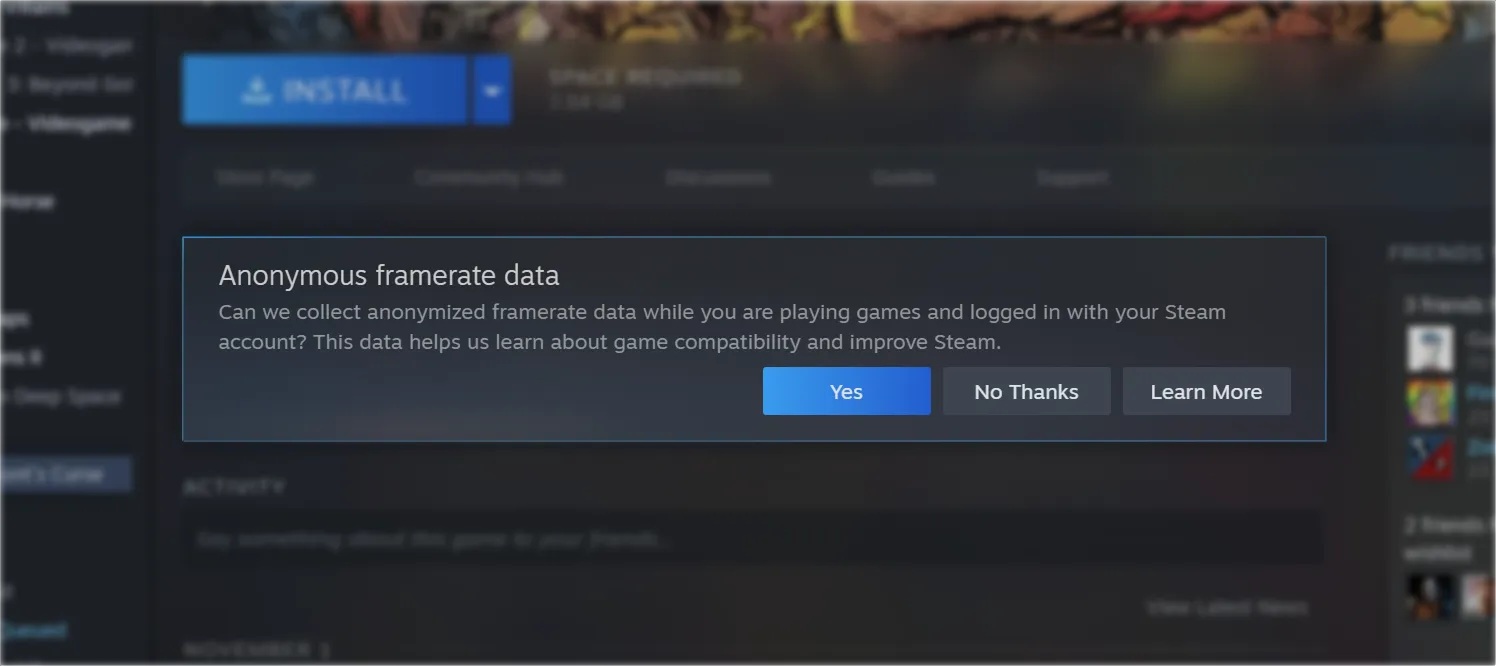
There is a second home for it. The same figures show up inside the Steam Library on the Steam Client Beta, so you can check a game you already own without opening a browser tab. The opt in prompt sits in that library view, and the permanent switch is buried in Account Settings, Data and Browsing, Anonymous game framerate data. You can turn it off whenever you want, and the post is upfront that the averages are built from people who left it on.
The histogram is the part that matters
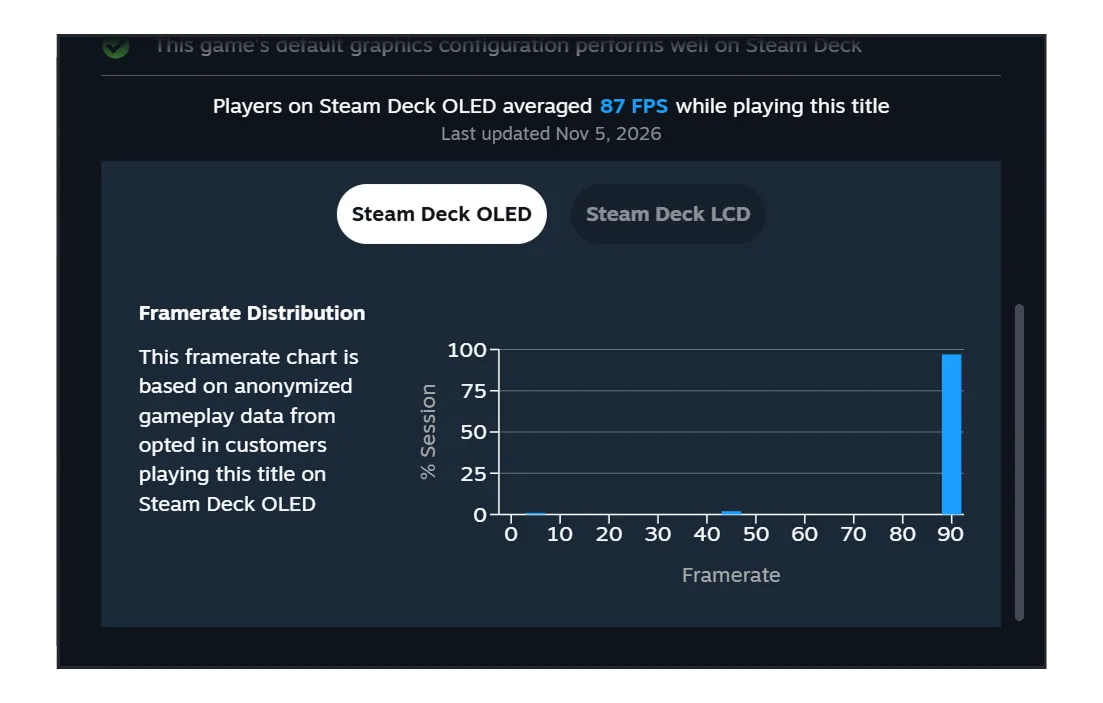
An average framerate is a liar's statistic on its own. A game that holds 60 through most of a session and collapses to 20 during a boss fight can still average out to something respectable. Valve knows that, which is why the update ships an expandable histogram showing the percentage of samples at each frame rate. Stutters and hitches show up as small columns down in the low numbers, right where a clean 60 fps average would hide them. That is a real diagnostic instead of another badge.
The reasoning behind the whole thing is refreshingly blunt. Valve's Steam News post says the Verified rating is based on standardized test criteria and may not match every customer's bar for acceptable gameplay. A game rated Unsupported because of unstable performance can still be playable to plenty of people. A Verified game can still run at a framerate you would not touch with a borrowed Deck. The average gives buyers a second opinion that the badge never provided, and it does it on the same page where the store asks for money.
There is an honest caveat buried in the FAQ, too. A game capped at 60 on an OLED panel set to 90 Hz will show a sawtooth pattern as VSync juggles frame delivery, and that pattern lands in the average. Valve explains the 90 and 45 gap directly, which is more transparency than most platform holders bother with. It also means a low number is not automatically a broken game, just a game running under a cap someone chose.
Desktop telemetry is the bigger story
The post buries its lede near the bottom. Valve calls this update a stepping stone toward framerate data for more devices than the Steam Deck, and it is already prompting desktop Steam users to opt in to anonymized framerate data through the beta client. That prompt ships to everyone later. Read that again: Steam is building a performance census of PC gaming, one opt in at a time, and the handheld is just the clean starting point because every Deck has identical hardware.
Desktop numbers will be a mess by comparison. GPUs, drivers, resolution and settings all vary, so an unsliced average tells you almost nothing. Valve surely knows that, and the Deck rollout is a way to test the presentation before it has to explain a thousand hardware combinations. PC Gamer reported in October that developers already had access to this frame rate data from October 1, along with the caveats about the LCD cap at 60 and the OLED panel at 90. It took another month for the same numbers to reach the people spending the money.
How the timeline took it
Reaction so far is thin and mostly technical. Wario64 was one of the first big accounts to flag the announcement, which is how a lot of people found out about a feature Valve shipped without a trailer or a countdown. Independent reaction beyond that is limited at the moment, so treat any claim of mass outrage or universal praise as premature. The feature is useful and boring, which is the correct shape for a storefront fix.
The obvious losers are games that shipped as Verified and cannot hold 30. Nobody has to argue about vibes anymore, because the histogram is sitting there showing a wall of samples down at 24. The obvious winners are games with ugly compatibility labels and clean frame times, the Unsupported title that suddenly has proof it runs at a steady 40. Both of those are real buying decisions, and both used to rest on a single tester's afternoon.
The CriticalPixel take
Verified has been a coin flip for years. I have installed green badge games that stuttered through the first cutscene and yellow badge games that held a flat 40 for six hours. Publishing raw averages does not fix the test suite, but it hands buyers a way to check the claim before they spend money, and that is worth more than another curated label with no evidence behind it.
My worry is the histogram turning into a scoreboard. Developers will optimize for the average, which is precisely the number that hides the worst ten minutes of a game. If Valve ever folds these figures into the Verified decision, watch how fast the bar moves to whatever the median Deck owner tolerates. Average performance is not the same thing as consistent performance, and a 45 fps mean with deep spikes is worse to play than a locked 30.
Privacy is the other bill coming due. Opt in language is doing a lot of work here, and the desktop rollout is where people will start paying attention. Valve should say what it collects, how long it keeps it, and whether desktop samples get tied to accounts. Promising anonymity in a settings menu is not the same as proving it under audit, and a storefront with this much telemetry owes its customers the specifics before the prompt goes wide.
For now this is the rare platform update that helps the person holding the console instead of the storefront selling it. Open any Deck tested game, scroll to compatibility, hit Learn more, and you get a number and a shape. That beats a badge and a prayer. If Valve follows through on more devices without a real conversation about consent, the goodwill from today will not survive the next patch note.
Sources
Steam News: Average framerate data is now available for games on Steam Deck
PC Gamer: Valve is telling devs how well their games actually run on Steam Deck with real world data